
When a business is just starting out with Telegram newsletters, the most obvious way is to take as many people as possible from a suitable chat and run a message across the audience. The logic seems simple: the larger the base, the higher the chance of getting leads.
But in chat rooms, volume does not always mean quality. One person joined the community a year ago and never opens it again. The other reads silently but makes decisions. The third post regularly, but does not relate to your intended role at all. Therefore, the question of “take all or only active” cannot be solved by volume. It is best viewed as a test of two different segments with different signal density.
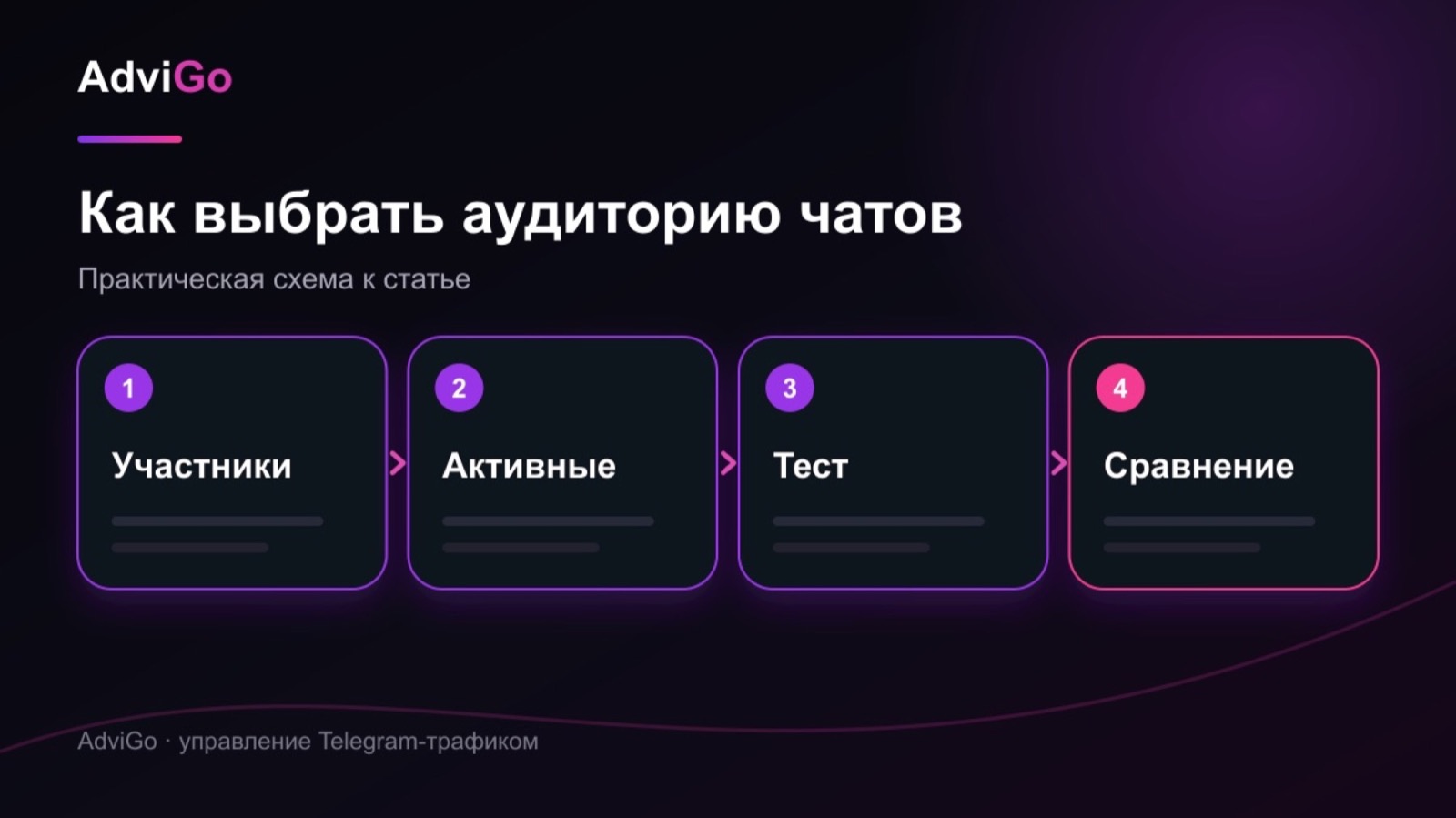
Why a list of all participants is not always the best
A wide sample of chat participants looks attractive because it gives scale. If the topic of community is narrow, it seems that almost everyone inside already fits the sentence.
In practice, the same chat can be business owners, employees, contractors, beginners, observers and just random subscribers. Formally, they relate to the same topic, but are in different contexts and react differently to the first message.
This does not mean that a large sample cannot be used. Sometimes it works well as a starting hypothesis or a control group. But before launching such an audience, it is especially important to clean up, check the random sample and make sure that the source really fits the task.
How useful are active authors
Active authors usually give a stronger signal. If a person has recently written in a chat, asked a question or participated in a discussion, it is more likely that the topic for him is alive and he is generally ready to interact on Telegram.
For a beginner, this is especially useful because an active audience is quicker to show how much they have gotten into the need and language of the message. Such users often give feedback on the first tests, which means that it is easier to adjust the offer and the structure of the first touch.
But activity alone does not make a person target. A competitor, expert, contractor or person without decision-making authority may participate in the discussion. Therefore, active authors can not be considered a ready-made base without additional verification.
Compare segments, not argue about approach
In practice, the best answer is not a theory, but a comparable test. Take two segments from one or more sources. In one, leave a wider audience of participants, in the other – only active authors. For both, use the same offer, the same test period, and a comparable amount of shipment.
If the context for active authors requires a slightly different liner, you can adjust the first phrase, but not change the sentence itself. Otherwise, you will simultaneously check the other segment and the other message, and then you will not understand what exactly influenced the result.
In AdviGo, such tests are conveniently bred for individual projects or campaigns. Then the answers don’t mix, and the team understands which segment it is working with in each case.
Look not only at the answers
Active writers can respond more often simply because they are used to chatting. But it is not the fact of the answer that matters to the business, but how far the user goes.
If one segment gives a lot of reactions, but almost no one goes into a substantive conversation, this is a weak result. If the other responds less often, but more often reaches qualifying and the next step, it may prove to be much more valuable.
Therefore, when comparing, it is useful to look at target answers, qualified leads and funnel movement. In AdviGo, it is convenient to do this through statuses and statistics. Statuses help to understand what happens with each dialogue, and statistics show which segment really gives a better result.
Not only the numbers, but the nature of the objections.
Sometimes the difference between segments is better seen not in the bare conversion, but in the user responses themselves.
If a broad sample often says “I don’t understand why you came to me,” the source is likely too broad or outdated. If active authors are willing to respond, but it quickly turns out that they do not make decisions or are not suitable for the role, then one criterion of activity is not enough.
In AdviGo, managers can conduct dialogues in one window and leave internal comments. This helps not only to process answers, but also to accumulate material for the next solution.
Most often, the combined approach wins.
In practice, the choice between “all participants” and “only active authors” is rarely final. It is much more useful to consider them as two stages of working with one audience.
You can test active authors first to get feedback faster and verify the message. Then, if the link is confirmed, carefully expand to a wider audience of participants, retaining separate analytics.
So the company does not abandon the volume, but does not immediately start from too blurred base. And most importantly, the decision to scale is made not by the size of the unloading, but by leads and further movement through the funnel.
The main thing is not the size of the segment, but its utility.
By themselves, all chat participants are no better or worse than active authors. These are just two different audiences with different signal density.
A wide sample yields more volume, but more often requires more careful cleaning and inspection. Active authors give less contact, but help to quickly understand whether the audience has a keen interest in the topic. For a beginner, this is why it is wiser to start with them and then expand gradually.
AdviGo helps to conduct such a test without chaos: divide segments by project, launch a newsletter, collect answers in one interface, conduct users by status and evaluate the result through statistics.
Then the question of “who to take from Telegram chat” turns not into a dispute about approaches, but into a normal working hypothesis that can be quickly tested and scaled only after confirming the result.