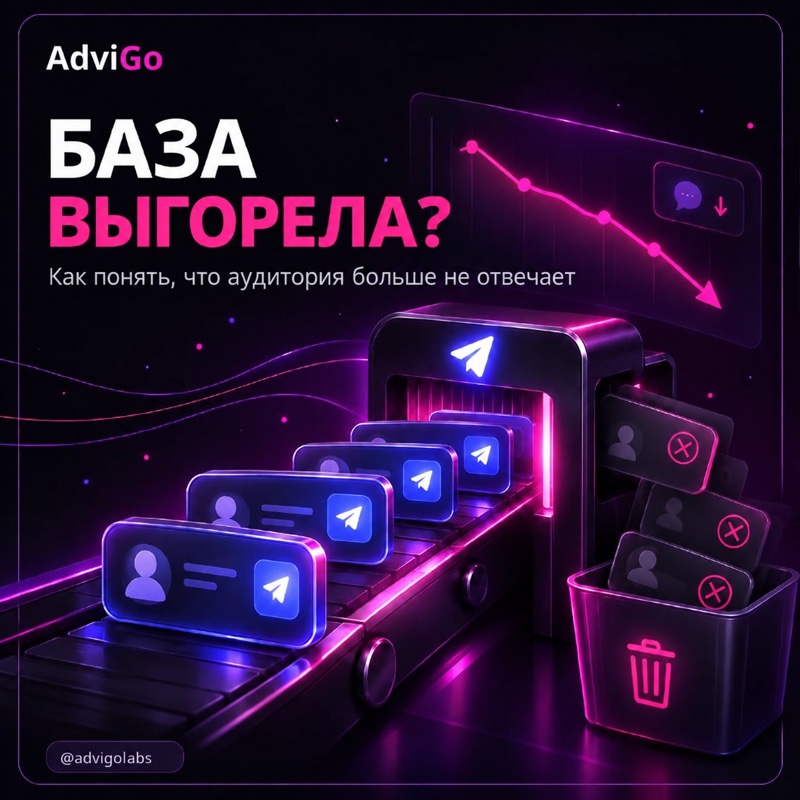
The same Telegram audience rarely delivers the same results indefinitely. At first, users reply actively, ask questions and progress through the funnel. After several campaigns, reactions become less frequent and rejections increase.
The usual response is to change the copy: a new greeting, a different opening question or a shorter offer. Sometimes that helps. Sometimes the message is no longer the problem.
A single weak campaign does not mean the list is exhausted. A decline can come from accounts, a new offer, timing or the team's work. First confirm that the audience itself has become the constraint.
Look at the trend, not one campaign
The main sign of audience fatigue is gradual deterioration under similar conditions, rather than a sudden one-day drop.
Suppose the same segment produces fewer relevant replies over three successive campaigns. Interest falls from 8% in the first test to 6%, then 3%, while the offer, volume and handling process stay almost unchanged.
That trend deserves investigation.
AdviGo's Statistics section makes results easy to compare. Look beyond total replies to how many users progress to relevant interest, qualification and the next step.
Check whether you contact the same people too often
A list may look large while containing many of the same people.
For example, you collect users from several topic-based chats. One person may belong to three of them and appear in several exports. If contact history is ignored, they will receive a similar offer again.
You may formally be using a “new list”, but for the recipient it is the third contact that month.
Before another launch, identify whom you have already contacted, when, and how the previous conversation ended.
If someone recently declined a specific offer, repeating the same wording is unlikely to change the result. You need a new reason or a different approach.
Watch how the nature of replies changes
Reply rate may not decline immediately. Sometimes the number of reactions stays similar while their quality deteriorates significantly.
Previously, users asked about price or terms, or requested a product demo. Now you see more short replies such as “not interested”, “already seen it”, “you contacted me before” or “not relevant”.
This is an important signal.
It shows that the audience still notices the messages, but no longer sees the offer as something new.
Compare the conversations themselves as well as the numbers.
Do not confuse offer fatigue with audience exhaustion
The audience may appear exhausted when users are simply tired of the same offer.
A simple test can help distinguish the two.
Keep the segment unchanged and change one thing: the offer itself. Do more than rephrase the text; present a different benefit or next step.
Check the technical side before replacing the list
A sudden decline can look like audience exhaustion even when the issue lies in infrastructure.
Some accounts may be unstable, actual sending volume may have fallen or proxies may be failing. Users simply receive fewer messages, while the team concludes that the audience has stopped reacting.
Before replacing the list, check whether actual outreach volume has been maintained.
AdviGo lets you centrally manage Telegram accounts and assign them to projects. See “Account management” for more details.
Do not discard the entire source
Even if part of the list is fatigued, the whole source is not necessarily useless.
Topic-based chats continually gain new members. Some have never seen your offer. Others have only recently begun discussing the topic actively. Some users' needs may have changed.
Try rebuilding the segment rather than abandoning the source entirely.
Return only with a new reason
The weakest follow-up strategy is to send almost the same message in different words.
A new contact needs a new reason.
That could be a new product feature, updated terms, a recent case study, a different offer format or a change in the customer's own needs.
The follow-up then has a clear purpose instead of looking like another attempt to send something the person has already ignored.
You can spot audience fatigue early
A Telegram list rarely stops working overnight. Signals usually emerge gradually: the share of relevant replies falls, rejections rise, more users recognize the message, and follow-ups produce fewer new leads.
When the team compares equivalent periods, keeps contact history and monitors the technical side separately, fatigue becomes something measurable rather than a subjective impression.
AdviGo connects statuses, conversation history, account management and statistics in one process.