Consistent Telegram lead generation does not come from one successful message or a large number of accounts. It depends on connected stages: the business finds an audience, launches outreach, receives replies, assigns them to representatives and only then evaluates the outcome.
Problems start when these stages operate separately. Marketing builds the list in one place, representatives reply elsewhere, and the manager sees only the final lead count without understanding where results are lost. Treat Telegram lead generation as one system rather than a collection of disconnected tasks.
Audience
Everything starts with a hypothesis about who should be interested and why, rather than with sending a message. A good list is not just usernames; it is an audience with a known origin. Understand where each contact came from, why it met your criteria and why the offer could be relevant.
Even beginners can follow a few basic rules. Save the source, collection date and segment immediately. If some contacts come from a topic-based chat, others through services such as TGStat or Telemetr, and others from competitors' communities, keep them separate until testing. Otherwise, it becomes difficult to tell which segment produced good leads and which merely increased sending volume.
Before launch, remove duplicates, bots, deleted profiles and clearly irrelevant contacts, then manually check a random sample. This preparation seems simple, but often determines whether outreach generates relevant replies or just noise.
Accounts and projects
The next layer is operational infrastructure. Even a good list will underperform if accounts are scattered across devices, representatives are unsure what they are working with and the manager cannot see which connections belong to which project.
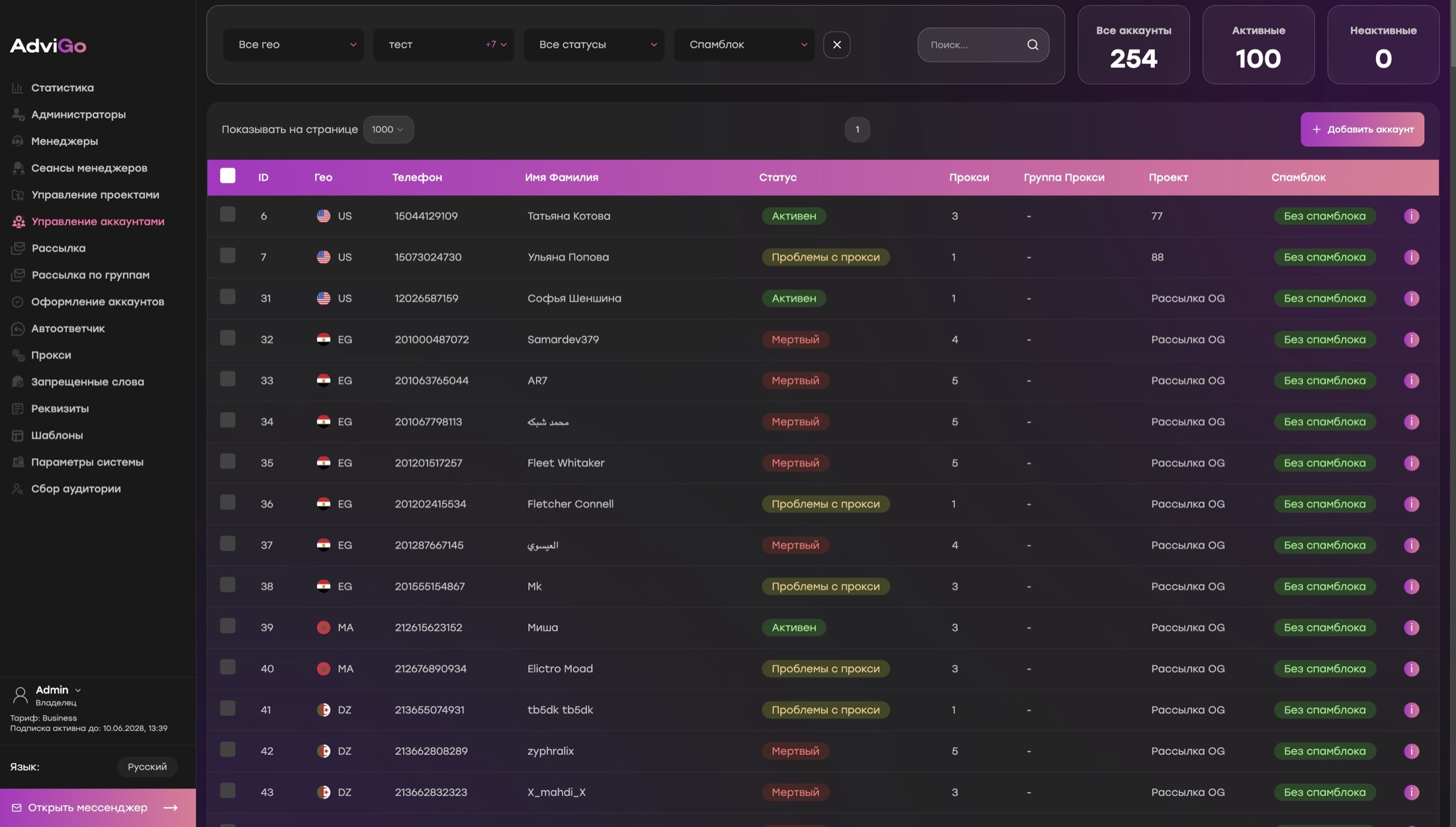
Organize accounts by project, geography or purpose in advance. One group can support a product, another a geographic market, and a third remain in reserve. This structure helps both daily operations and diagnosis: when metrics decline, it is easier to identify whether the issue lies in the audience, project or a particular account group.
AdviGo centralizes Telegram account management. Accounts can be assigned to projects, and employees can receive access only to the areas they work on. This becomes especially important as the team grows and you need to keep control without sharing the same account sessions with everyone.
Outreach
Once the list and infrastructure are ready, outreach can begin. Consistent results still come from systematic testing, rather than sending to everyone and seeing what happens.
Keep the first send limited. Test one hypothesis on a small segment instead of immediately applying a message to the whole list and then struggling to explain the outcome. Change only one factor per test: segment, offer, message structure or timing. Changing everything at once makes analysis meaningless.
AdviGo bulk messaging works with uploaded user lists and existing conversations. Messages can contain plain text, media and spintax.
Handling replies
Many people think outreach ends when a user replies. In practice, that is where the most important stage begins. If no one owns the reply, the representative joins late or does not understand the opening message, leads are lost after an otherwise successful contact.
Before launching, decide how the team will handle replies. Every new conversation needs a clear owner, and the funnel needs simple, consistently understood statuses. A few stages are usually enough: new reply, relevant interest, qualification, next step, sale and rejection. A status is of little use if it does not indicate what to do next.
This is also where templates, automated replies and automatic translation help. Automated replies handle repetitive actions such as greetings or straightforward keyword requests. Templates speed up routine responses. Translation integrates international conversations into the same workflow. None of these should replace meaningful work with an interested lead. Real interest or an unusual question should bring a representative into the conversation quickly.
Security
As the team grows, Telegram lead generation becomes a security concern as well as a sales task. Giving representatives unrestricted access to accounts, client lists, sensitive data and payment details leaves the system dependent on individual behavior.
It is more reliable to build security into the workflow. Representatives work with conversations inside the system rather than receiving full control of a Telegram session. Access is limited by role, while critical actions remain under administrator control. This helps protect infrastructure, customers and internal processes.
AdviGo supports this approach within its workspace. You can restrict employees by project and role, hide selected client information, define prohibited words and control payment details.
Analytics
The final layer connects all the others into a manageable system. Without analytics, Telegram lead generation soon turns into impressions: “the list seemed weak”, “the team probably could not keep up” or “the message seemed less effective”.
Break the funnel into stages to see what is happening. Usually it is enough to monitor list volume, conversations started, all replies, relevant replies, qualified leads, the next commercial step and sales. It also helps to track the time to a representative's first reply and how long conversations remain in each status.
The system works only when its parts are connected
The main mistake in Telegram lead generation is improving one area without seeing the whole chain. A large list can fail because of a weak message. Strong outreach can overwhelm the sales team. Many replies can conceal which segments actually produce sales.
A consistent flow of leads therefore comes from a connected system: a clearly defined audience, organized accounts, careful outreach, controlled reply handling, built-in security and transparent analytics.
AdviGo brings these parts into one workspace: account management, outreach, conversations, statuses, team access, security controls and analytics. The business can scale a process where the source of each lead, the state of each conversation and the outcome of each project are visible, instead of scaling a chaotic collection of tasks.