You can connect 10 Telegram-accounts, and you can 100 – by itself their number says nothing about the result. If the database is poorly selected or managers do not have time to process answers, additional accounts will simply increase the amount of work.
Therefore, it is better to determine the number of accounts not with a margin, but based on a specific goal: how many leads you need to get, how many contacts you will need and how much the team can process.
First, calculate how many contacts you need.
Start with a lead plan. For example, a project needs to receive 100 qualified leads per month. If, according to the results of previous launches, one lead appears on average for every 80 contacts, the calculation is simple:
100 leads × 80 contacts = 8,000 contacts per month.
At 20 working days, about 400 contacts per day must be processed.
If your own statistics are not yet available, do not take a random conversion from the Internet. It is better to do a small test on parts of the base, get the first real indicators and use them as a working hypothesis.
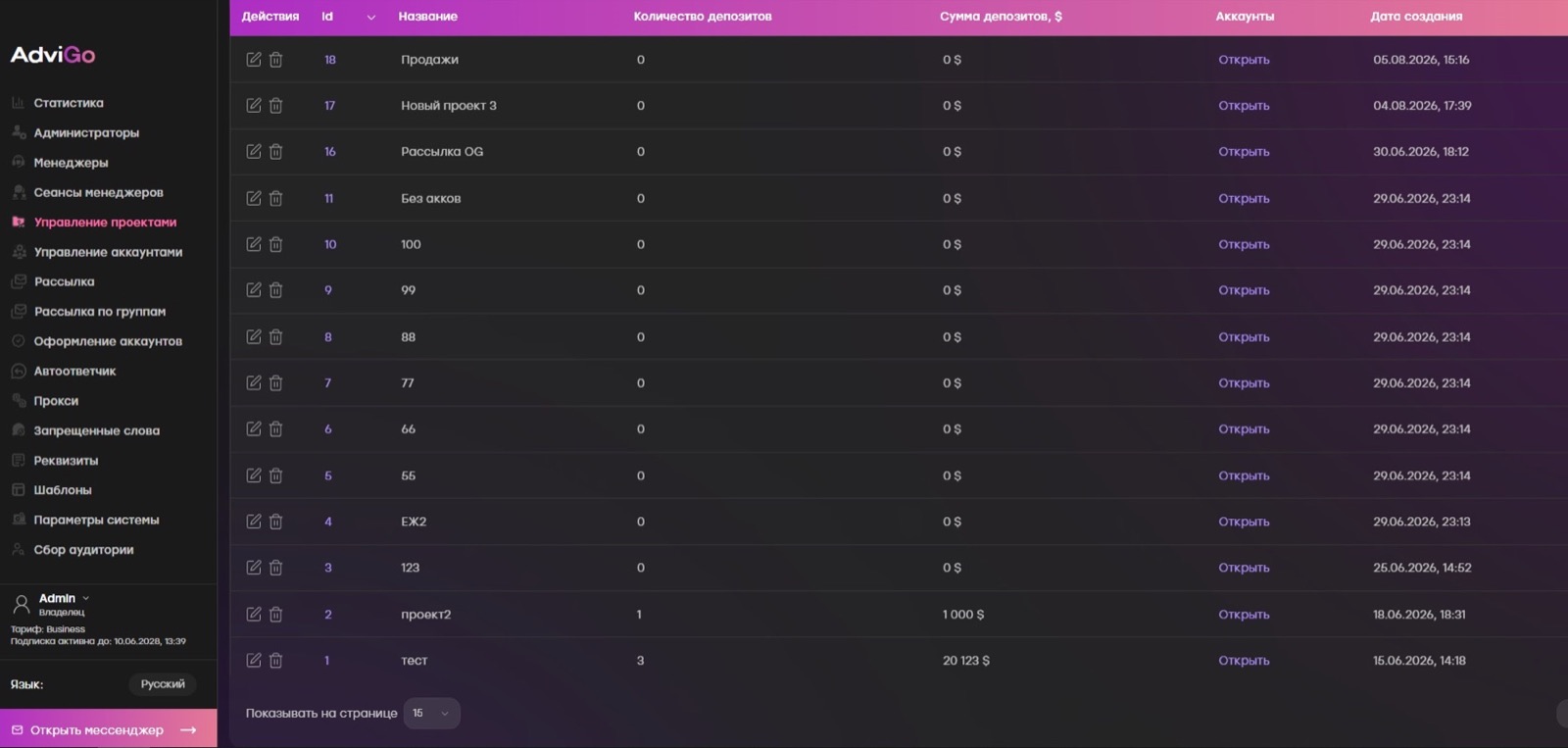
После следующих запусков расчёт можно корректировать. Посмотреть результаты работы и сравнить показатели можно в AdviGo section "Statistics".
Now determine the number of accounts
When the required daily volume is known, it can be distributed among workers Telegram accounts.
Let’s say you need to process 400 contacts a day. Next, you need to determine a stable workload of one account, taking into account your settings, account status and Telegram restrictions.
The formula looks like this:
Required amount of contacts per day ÷ workload of one account = required number of active accounts.
For example, if your infrastructure’s operating mode allows you to distribute the daily volume among 10 accounts, each of them should provide about a tenth of the required number of contacts.
But you need to count active work accounts, not everything that is added to the system. Part of the accounts may be in reserve, under review or temporarily not used.
Don't forget the managers.
There is another limitation that is easy to forget. A newsletter can produce more answers than the team can physically process.
Let’s say that after the number of accounts increased, the number of responses doubled, and the number of managers remained the same. New dialogues begin to wait, the time of the first response increases, and some interested users lose interest.
In this case, increasing the number of accounts does not help to execute the plan – it creates a queue.
Therefore, before scaling, it is worth separately determining how many new dialogues managers are able to process qualitatively per shift. If the infrastructure can create 300 new calls per day, and the team can only handle 150, the lead processing needs to be addressed first.
In AdviGo, Telegram accounts and dialogues are gathered in a single workspace, so managers do not have to constantly switch between individual applications and sessions. This makes it easier to work with the growing number of incoming calls.
More information about the system can be found in the AdviGo manual.
Keep some accounts in reserve
Do not assume that every account added will be available all the time. In practice, individual accounts may be temporarily out of work or require verification.
Therefore, it is useful to divide the infrastructure into at least two parts: work accounts that provide the necessary volume, and backup accounts that can be connected if necessary.
For example, if you constantly need 20 active accounts to execute your daily plan, building the entire system on exactly 20 accounts is risky. Any problem will immediately reduce the available power and affect the outcome of the campaign.
The reserve allows you to replace the dropped account, without rebuilding the entire process and without stopping the work of others.
Increase the number gradually
If the calculation shows that significantly more accounts will be required to execute the plan, you do not need to connect the entire volume at once.
It is more practical to move in stages: launch the first group of accounts, look at the number of sending and responding, check the quality of leads and the load of managers, and then increase the volume.
For example:
10 accounts → result check → 20 accounts → recheck → further scaling.
So it's easier to see the moment when the growth of infrastructure stops giving proportionate growth.
The reason may not be the number of accounts. When scaling, a quality audience may run out, the effectiveness of the message may decrease, or a queue may arise from raw dialogues.
Count accounts from the economy, not vice versa
Ultimately, the goal is not to connect as many Telegram accounts as possible. Accounts are just the infrastructure to achieve a business goal.
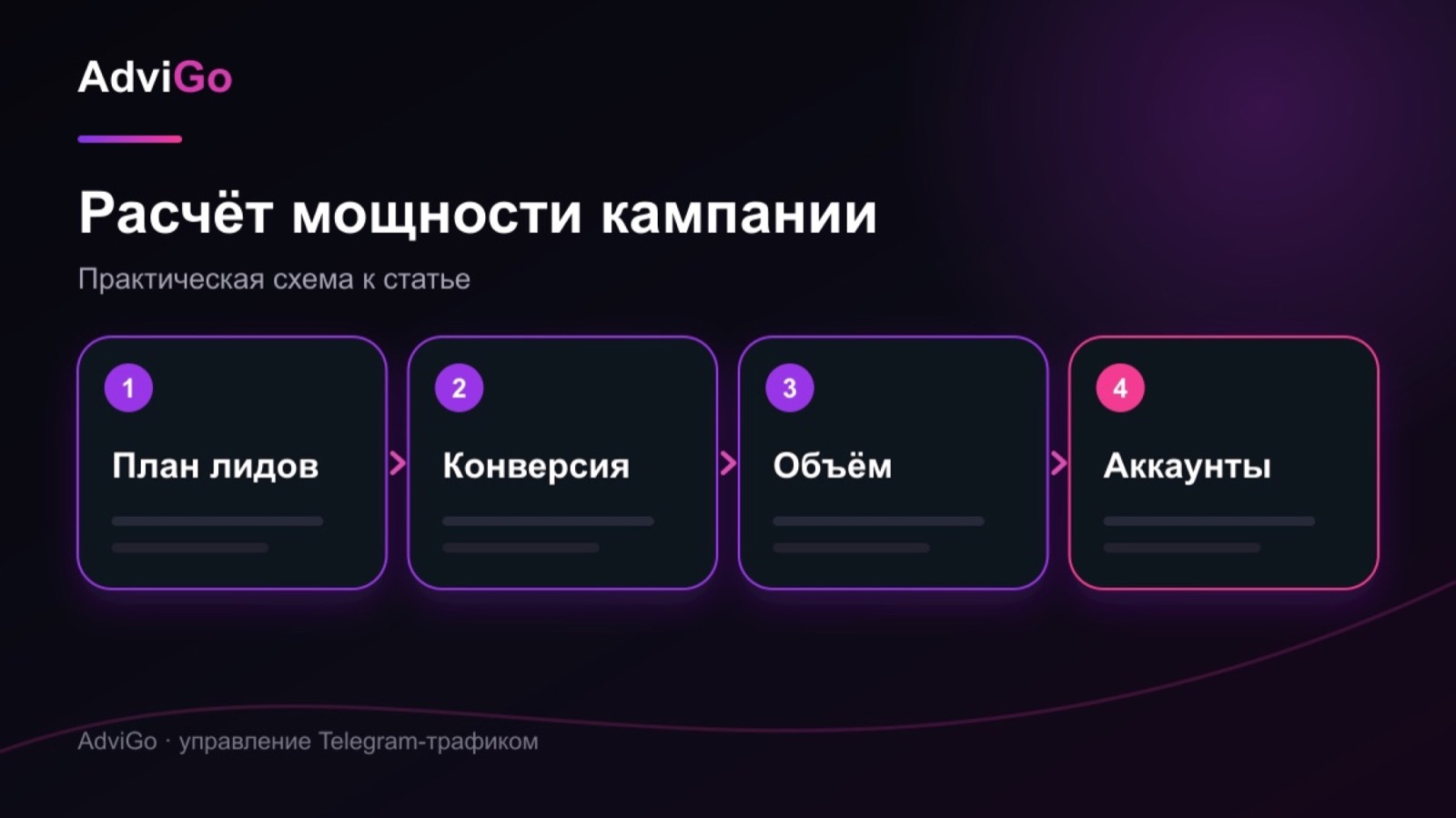
The logic of the calculation should be consistent:
lead plan → required number of contacts → daily volume → number of work accounts → necessary team power.
After launch, the real indicators should be compared with the calculation and gradually adjust the system.
If the plan is executed on 20 accounts, it makes no sense to connect another 30 just for the sake of scale. If the current infrastructure is lacking, on the contrary, it becomes clear how much additional resources are really needed.
The correct number of Telegram accounts is not a universal number. This is a value that depends on your base, conversion, lead plan, and the team’s ability to handle the resulting stream.
AdviGo helps to collect accounts, mailings and further work with dialogues in one space, so that scaling remains manageable, and the number of connections is associated with real business tasks.